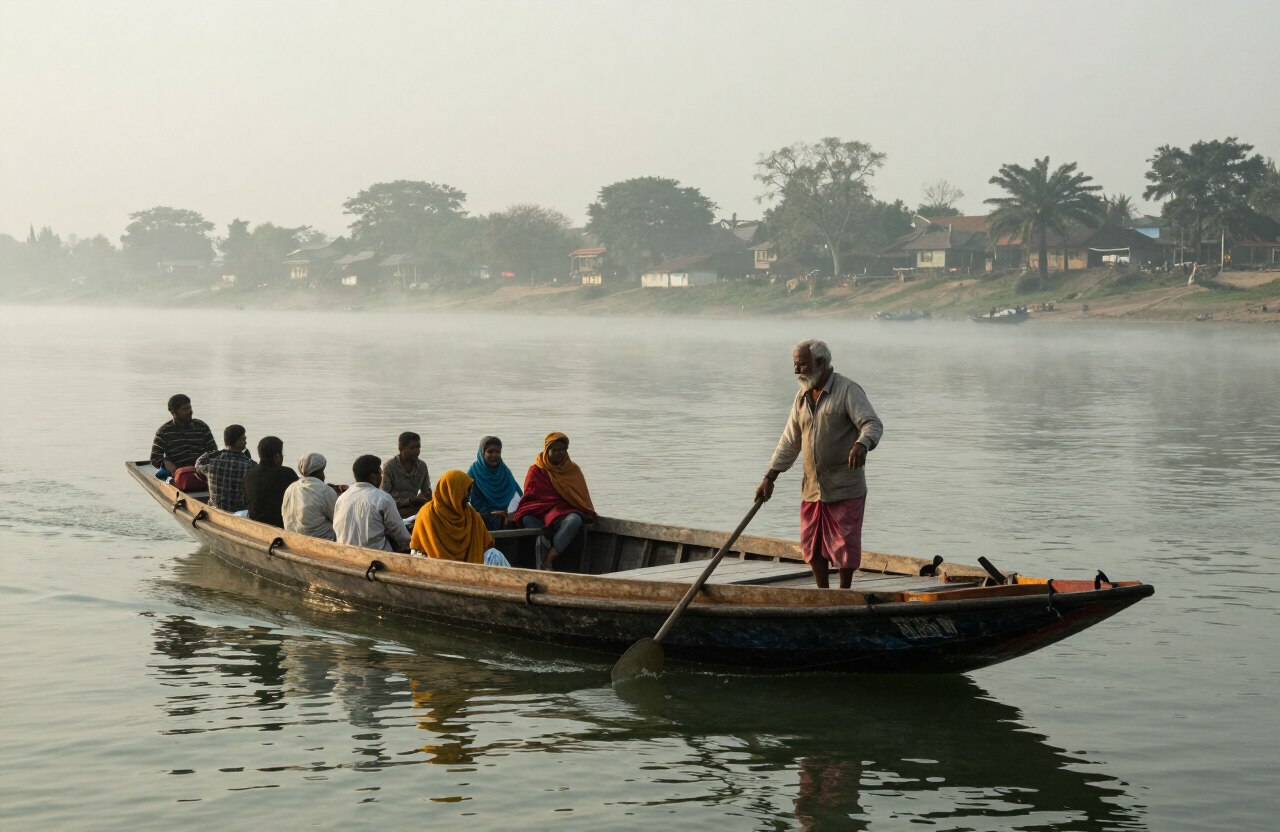
MAJULI, ASSAM — The ferry leaves at dawn because it has always left at dawn. Mohan Das, sixty-one, has steered this crossing for forty years, and he can read the Brahmaputra the way you read a face — the colour of the water, the angle of the current against the hull, the smell of silt that means the river is rising somewhere upstream.
His ferry carries forty passengers, six motorcycles, two bicycles and, on market days, a goat or three. The crossing takes an hour. When the new bridge opens next year, eight kilometres downstream, the same journey will take ten minutes by road. Everyone on the river knows what that means.
“The bridge will take ten minutes. The river takes an hour. But the river is where the news travels.”
The Brahmaputra is less a river than a moving country — five kilometres wide in places, braided with sandbars that appear and vanish between monsoons, home to river islands like Majuli that are among the most densely populated rural landscapes on earth. For centuries, the ferries were not transport. They were the institution: post office, market, ambulance and news service in one.
“The bridge will take ten minutes. The river takes an hour,” says Das, throttling down as the ferry noses into the eastern ghat. “But the river is where the news travels. On the bridge, nobody talks.”
The state’s bridge-building programme is genuinely transformative. Island communities have lost decades to the river’s moods — a pregnant woman in labour waiting for a ferry is a story every family here can tell. Nobody on Majuli opposes the bridges. The grief is quieter than opposition: it is the grief of a trade ending not with a bang but with a timetable.
Some boatmen have already adapted. Two of Das’s nephews run the new tourist launches that take visitors to the island’s satras — the neo-Vaishnavite monasteries that make Majuli a cultural treasure. The tourism money is better than the ferry money ever was. It is also seasonal, fickle and dependent on a world beyond the river in a way the ferry never was.
The government’s transition scheme offers licensed boatmen compensation and retraining vouchers. Take-up has been slow. “They are offering to teach me computers,” Das says, with the polite incredulity of a man who can navigate a five-kilometre-wide river by the stars. “I am sixty-one.”
On the return crossing, the morning mist burns off and the river turns the colour of old brass. Das points to the bridge pylons rising on the horizon — concrete legs in the water, marching toward each other from either bank. “It is good,” he says at last, and means it, and means the other thing too. “The river will still be here. It will just be lonelier.”